Loading... Please wait...
Categories
Categories
- Home
- Automotive
- Automakers
- General Motors 1931 - Alfred P Sloan as president
General Motors 1931 - Alfred P Sloan as president


General Motors 1931 - Alfred P Sloan as president

Product Description
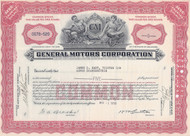
General Motors Coporation stock certificate 1931 - Alfred P Sloan printed signature as president
Very nice cert with top vignette of allegorical figures representing industry, flanking the famous GM logo. Issued to the New York Life Insurance Company, dated May 21, 1931. Great historical document with company and famous CEO name recognition.
General Motors Company, commonly known as GM, is an American multinational corporation headquartered in Detroit, Michigan, that designs, manufactures, markets and distributes vehicles and vehicle parts and sells financial services. General Motors produces vehicles in 37 countries under thirteen brands. General Motors led global vehicle sales for 77 consecutive years from 1931 through 2007, longer than any other automaker, and is currently among the world's largest automakers by vehicle unit sales.
In 2009, General Motors shed several brands, closing Saturn, Pontiac and Hummer, and emerged from a government-backed Chapter 11 reorganization. In 2010, the reorganized GM made an initial public offering that was one of the world's top five largest IPOs to date and returned to profitability later that year.
The company was founded on September 16, 1908, in Flint, Michigan, as a holding company for McLaughlin Car Company of Canada Limited and Buick, then controlled by William C. Durant. GM's co-founder was Charles Stewart Mott, whose carriage company was merged into Buick prior to GM's creation. Over the years Mott became the largest single stockholder in GM. GM acquired Oldsmobile later that year. In 1909, Durant brought in Cadillac, Elmore, Oakland and several others. Also in 1909, GM acquired the Reliance Motor Truck Company and the Rapid Motor Vehicle Company, the predecessors of GMC Truck. Durant lost control of GM in 1910 along with R. S. McLaughlin to a bankers' trust, because of the large amount of debt taken on in its acquisitions coupled with a collapse in new vehicle sales.
The next year, Durant started the Chevrolet Motor Car Company in 1911 in the U.S. in Canada in 1915 and through this he secretly purchased a controlling interest in GM. Durant took back control of the company after one of the most dramatic proxy wars in American business history. Durant then reorganized General Motors Company into General Motors Corporation in 1916 Merging General Motors of Canada Limited as an ally in 1918. Shortly after, he again lost control, this time for good, after the new vehicle market collapsed. Alfred P. Sloan was picked to take charge of the corporation and led it to its post-war global dominance.This unprecedented growth of GM would last into the early 1980s when it employed 349,000 workers and operated 150 assembly plants.
ALFRED P SLOAN
Alfred Pritchard Sloan, Jr. (1875 – 1966) was an American business executive in the automotive industry. He was a long-time president, chairman, and CEO of General Motors Corporation.Sloan, first as a senior executive and later as the head of the organization, helped GM grow from the 1920s through the 1950s, decades when concepts such as the annual model change, branding, industrial design, automotive design, and planned obsolescence transformed the industry.
Born in New Haven, Connecticut, Sloan studied electrical engineering initially at Brooklyn Polytechnic Institute, then transferred to and graduated from the Massachusetts Institute of Technology in 1895.
Sloan became president and owner of Hyatt Roller Bearing, a company that made roller- and ball-bearings, in 1899. Oldsmobile was Hyatt's first automotive customer, with many other companies soon following suit. In 1916 Hyatt merged with other companies into United Motors Company, which soon became part of General Motors Corporation. Sloan became Vice-President of GM, then President (1923), and finally Chairman of the Board (1937).
Sloan and the management of GM in the 1930s and early 1940s – the time of the Great Depression, German re-armament, fascism, appeasement, and World War II – are part of a larger narrative about the complex nature of multinational corporations. The war showed how nationality was not irrelevant to multinational corporations, as the national governments on both sides of the Allied–Axis divide used the industrial capacity of GM – the Allies utilizing Detroit and Vauxhall, while the Axis use Adam Opel AG, GM's German subsidiary – to churn out materiel for their war efforts.
Like Henry Ford – a contemporary of Sloan's with a rather special relationship to him as the other "head man" of an automotive colossus – Sloan is remembered today with a complex mixture of admiration for his accomplishments, appreciation for his philanthropic legacy, and unease or reproach about his attitudes during the interwar period and World War II. The Alfred P. Sloan Foundation is a philanthropic non-profit organization established by Sloan in 1934. The Foundation's programs and interests fall into the areas of science and technology, standard of living, economic performance, and education and careers in science and technology. The total assets of the Sloan Foundation have a market value of about $1.8 billion