Loading... Please wait...
Categories
Categories
- Home
- RR Bonds on Clearance
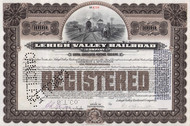
- Lehigh Valley Railroad $1,000 gold bond certificate c1940s (Pennsylvania) - green
Lehigh Valley Railroad $1,000 gold bond certificate c1940s (Pennsylvania) - green


Lehigh Valley Railroad $1,000 gold bond certificate c1940s (Pennsylvania) - green

Product Description
Lehigh Valley Railroad $1,000 gold bond certificate c1940s (Pennsylvania) - green
PA RR conglomerate. Nice vignette of a railyard with trains and workers building tracks. Horizontal format. Issued and cancelled. Dated 1940s. Vertical folds from storage. Measuring approximately 15 x 10 inches. GREEN version.
See other colors of this LVRR bond style in our listings!
The Lehigh Valley Railroad was one of several railroads built in the northeastern United States primarily to haul anthracite coal. It was authorized 1846 in the U.S. state of Pennsylvania and incorporated 1847 as the Delaware, Lehigh, Schuylkill, and Susquehanna Railroad Company. In 1853, the name was changed to Lehigh Valley Railroad.
The route was surveyed and grading started in 1850, but progress was slow and financing was insufficient. The railroad's growth occurred after Asa Packer invested in the railroad in 1852, and it was renamed the Lehigh Valley Railroad (LVRR).
In 1864, the LVRR began acquiring feeder railroads and merging them with its system. The first acquisitions were the Beaver Meadow Railroad and Coal Company and the Penn Haven and White Haven Railroad. In 1866 the company acquired the Lehigh and Mahanoy Railroad, and a further round of acquisitions took place in 1868 with the addition of the Hazleton Railroad and the Lehigh Luzerne Railroad. The LVRR scored a coup by obtaining the charter formerly held by the Schuykill Haven and Lehigh River Railroad in 1886. That charter had been held by the Reading Railroad since 1860.
After the U.S. entered World War I, the railroads were nationalized to prevent strikes and interruptions. The United States Railroad Administration controlled the railroad from 1918 to 1920, at which time control was transferred back to the private companies. Following the Great Depression, the railroad had a few periods of prosperity, but was clearly in a slow decline.
Two final blows fell in the 1950s: the passage of the Federal-Aid Highway Act in 1956, better known as the Interstate Highway Act, and the opening of the Saint Lawrence Seaway in 1959. The Pennsylvania Railroad in 1962 requested ICC authorization to acquire complete control of the LVRR through a swap of PRR stock for LVRR and elimination of the voting trust that had been in place since 1941. It managed to acquire more than 85% of all outstanding shares, and from that time the LVRR was little more than a division of the PRR. The Pennsylvania merged with the New York Central in 1968, but the Penn Central failed in 1970, causing a cascade of failures throughout the East.
The Lehigh Valley RR remained in operation during the 1970 bankruptcy, as was the common practice of the time. In 1972, the Lehigh Valley assumed the remaining Pennsylvania trackage of the Central Railroad of New Jersey. In 1976, major portions of the assets of the bankrupt Lehigh Valley Railroad were acquired by Conrail. Most of the equipment went to Conrail as well, but 24 locomotives went to the Delaware & Hudson. The remainder of the assets were disposed of by the estate until it was folded into the non-railroad Penn Central Corporation in the early 1980s.
Product descriptions and images
Please note that some pictures may only be representative of the inventory available. If we have more than one piece, we are unable to scan and display every piece. Unless otherwise noted, that there are variations for signatures, cancellation marks/holes, serial number, and dates. Colors will be as noted and pictured.