Loading... Please wait...
Categories
Categories
- Home
- Railroad
- 1800's Railroads
- Atlantic, Mississippi and Ohio Railroad 1871
Atlantic, Mississippi and Ohio Railroad 1871


Atlantic, Mississippi and Ohio Railroad 1871

Product Description
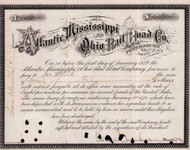
Atlantic, Mississippi and Ohio Railroad stock certificate 1871
Unusual pink certificate from just after the Civil War. Low serial number at 143 makes this a great collectible. Issued and not cancelled. Dated 1871.
Atlantic, Mississippi and Ohio Railroad (AM&O) was formed in 1870 in Virginia from 3 east-west railroads which traversed across the southern portion of the state. Organized and led by former Confederate general William Mahone (1826-1895), the 428-mile line linked Norfolk with Bristol, Virginia by way of Suffolk, Petersburg, Lynchburg, and Salem. The AM&O was promoted as a trade link to the west, and further expansion was envisioned with the goal of increasing Virginia's Ohio Valley and Mississippi Valley commerce. It was heavily backed by investors from England and Scotland.
The AM&O went into receivership after the U.S. Financial Panic of 1873. After several years of continuing financial problems, Mahone's relationship with the bondholders soured, and he was removed as trustee, but was permitted to continue to lead operations. Finally, in 1881, the AM&O was sold at auction. It was acquired by other U.S. interests based in Philadelphia who outbid Mahone. They were already building Shenandoah Valley Railroad and had a new commodity in mind: bituminous coal. The AM&O was renamed to Norfolk and Western Railway (N&W). Norfolk & Western Railway was expanded west into the coalfields, and later into a much large system, eventually tapping the Ohio Valley and Mississippi Valley commerce as earlier promised Virginia. The N&W was combined with the Southern Railway, another profitable carrier, to form Norfolk Southern Corporation (NS) in 1982.
Today, much of the former Atlantic, Mississippi and Ohio Railroad remains in service for Norfolk Southern. The Fortune 500 company, headquartered in Norfolk, transports bituminous coal, intermodal shipping containers, automobile parts and completed vehicles, and other commodities in the 21st century global transportation markets. Most of the former AM&O lines are still part of the NS rail network.
Three pre-civil war era railroad lines were combined to form the AM&O. They are listed from east to west:
Norfolk and Petersburg Railroad
The Norfolk and Petersburg Railroad, organized by Dr. Francis Mallory of Norfolk was built between 1853 and 1858 by a young civil engineer named William Mahone (1826-1895). It featured an innovative and durable roadbed through a portion of the Great Dismal Swamp and an arrow-straight 52-mile tangent between Suffolk and Petersburg. Mahone was named its head in 1860.
South Side Railroad
The oldest predecessor was the City Point Railroad a 9 miles (14 km) long line to Petersburg completed in 1838. In 1854, it became part of the South Side Railroad. The South Side Railroad was the middle section of the AM&O, stretching 132 miles from City Point (part of today's City of Hopewell) to Lynchburg in 1854.
Virginia and Tennessee Railroad
The Virginia and Tennessee Railroad extended 204 miles (328 km) from Lynchburg to Bristol. It made important westward connections which reached New Orleans, Louisiana, before the war began in 1861.
All three railroads were severely damaged during the American Civil War (1861-1865). After Virginia seceded in April 1861, William Mahone, as its president, used the Norfolk and Petersburg Railroad (N&P) to deliver a small force to Norfolk to secure the Gosport Navy Yard, an important resource for the Confederacy. After Union leaders declined a request to surrender possession, he used an N&P train and other deception to bluff them into thinking large numbers of rebel troops were arriving, causing them to abandon the shipyard with no loss of life. He accepted a commission in the Confederate Army and during the remainder of 1861 and until May 1862, also continued as head of the N&P. Mahone was relieved of N&P duties in 1862 as he took on increasing responsibilities with the Confederate Army. He was active in many campaigns and was an able leader during the war, best known as the hero of the Battle of the Crater in 1864 where he rallied troops and foiled an initial Union success during the Siege of Petersburg.
After the end of hostilities, defeated Confederate General Robert E. Lee advised his generals to go back to work rebuilding. William Mahone did just that. He returned to his old job and quickly set about repairing the N&P. Meanwhile, the managers of the South Side Railroad and Virginia and Tennessee Railroad also worked hard to restore service and rebuild bridges, stations, and rolling stock. The war had demonstrated the need to consolidate resources and connections, and the stockholders of the South Side Railroad elected Mahone as president of their road also before the end of 1865.
It was known that the Baltimore and Ohio Railroad (B&O) and other northern interests were trying to develop connections in the Shenandoah Valley which would favor Baltimore over Norfolk and other Virginia ports. Mahone could see that the Virginia and Tennessee Railroad was the key to western connections for the other two roads and he became a driving force in the linkage of N&P, South Side Railroad and the Virginia and Tennessee Railroad (V&T). He was president of all three by the end of 1867. However, the V&T board was opposed to consolidation which was favored by the other two roads. Rumors indicated that the B&O would expand its Valley line southward to meet the V&T near Salem, Virginia. Ultimately, the B&O did reach as far as up the valley as Lexington, Virginia, only 50 miles short of reaching Salem.
When Mahone could not persuade the V&T board, he took another route to force consolidation, and worked diligently in lobbying the Virginia General Assembly, a part-owner of all three roads, to gain the legislation necessary to combine them into a single entity, and expand westward.
William Mahone (December 1, 1826 – October 8, 1895) was a civil engineer, railroad executive, soldier and politician.
As a young man, Mahone was prominent in the building of Virginia’s roads and railroads. As chief engineer of the Norfolk and Petersburg Railroad, he built log-foundations under the swamp that are still intact today. According to local tradition, several of the new railroad towns were named after the novels of Sir Walter Scott, a favourite author of Mahone’s wife Otelia.
In the American Civil War, Mahone was pro-secession and served as a Confederate general. He was best known for regaining the initiative at Petersburg, when the Southern troops were in shock after a huge mine was exploded beneath them (Battle of the Crater, July 1864), and his counter-attack turned the engagement into a disastrous Union defeat.
After the war, he returned to railroad building, merging three lines to form the important Atlantic, Mississippi and Ohio Railroad (AM&O), headquartered in Lynchburg. He also led the Readjuster Party, a coalition of blacks, Republicans and Conservative Democrats, becoming an independent Senator in 1881. His willingness to caucus with Republicans cost him some support from the white electorate, as did his relatively lenient treatment of African Americans.