Loading... Please wait...
Categories
Categories
- Home
- Railroad
- Modern Railroads
- Norfolk and Western Railway $1000 bond 1987 (now Norfolk Southern)
Norfolk and Western Railway $1000 bond 1987 (now Norfolk Southern)


Norfolk and Western Railway $1000 bond 1987 (now Norfolk Southern)

Product Description
Norfolk and Western Railway $1000 bond 1987 (now Norfolk Southern)
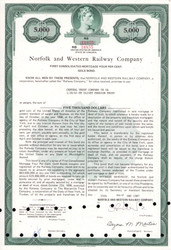
Nice railroad bond certificate with vignette of classical male bust. $1000 denomination. Issued and cancelled. Dated 1987. Measures approximately 9.5 x 13.5 inches. Brown border and vignette color.
The Norfolk and Western Railway was formed by more than 200 railroad mergers between 1838 and 1982. It was headquartered in Roanoke, Virginia, for most of its 150-year existence. Its motto was "Precision Transportation"; it had a variety of nicknames, including "King Coal" and "British Railway of America" even though the N&W had mostly articulated steam on its roster. NW was famous for manufacturing its own steam locomotives, which were produced at the Roanoke Shops, as well as its own hopper cars.
In December 1959, NW merged with the Virginian Railway, a longtime rival in the Pocahontas coal region. By 1970, other mergers with the Nickel Plate Road and Wabash formed a system that operated track from North Carolina to New York and from Virginia to Illinois. In 1982, NW merged with the Southern Railway, another profitable carrier, to form the Norfolk Southern Corporation (NS), but it continued paper operations until it was merged into the Norfolk Southern Railway in 1997.
NW's earliest predecessor was the City Point Railroad (CPRR), a short-line railroad formed in 1838 to extend from City Point (Hopewell, Virginia), a port on the tidal James River, to Petersburg, Virginia, on the fall line of the shallower Appomattox River. In 1854, CPRR became part of the South Side Railroad, which connected Petersburg with Lynchburg, where it interchanged through traffic with the Virginia and Tennessee Railroad (V&T) and the James River and Kanawha Canal.
In 1881, the AM&O was reorganized and renamed Norfolk and Western, a name perhaps taken from an 1850s charter application filed by citizens of Norfolk, Virginia. George Frederick Tyler became president. Frederick J. Kimball, a civil engineer and partner in E.W. Clark & Co., became First Vice President. Henry Fink, whom Mahone had hired in 1855, became Second Vice President and General Superintendent.
In 1886, the NW tracks were extended directly to coal piers at Lambert's Point, which was located in Norfolk County just north of the City of Norfolk on the Elizabeth River, where one of the busiest coal export facilities in the world was built to reach Hampton Roads shipping. The opening of the coalfields made NW prosperous and Pocahontas coal world-famous. By 1900, Norfolk was the leading coal exporting port on the East Coast.
VGN was conceived and built by William Nelson Page and Henry Huttleston Rogers. Page had helped engineer and build the Chesapeake & Ohio Railway (C&O) through the mountains of West Virginia and Rogers had already become a millionaire and a principal of Standard Oil before their partnership was formed early in the 20th century. Initially, their project was an 80-mile long short line railroad. After failing to establish favorable rates to interchange coal traffic with the big railroads, the project expanded. Rogers was apparently a silent partner in the early stages, and the bigger railroads did not take Page seriously. They accomplished this right under the noses of the pre-existing and much bigger C&O and NW railroads and their leaders by forming two small intrastate railroads, Deepwater Railway, in West Virginia, and Tidewater Railway in Virginia. Once right-of-way and land acquisitions had been secured, the two small railroads were merged in 1907 to form the Virginian Railway.
When the Interstate Commerce Commission (ICC) approved VGN's 1959 merger into NW, it heralded a merger movement and a modernization of the entire U.S. railroad industry. In 1964, the former Wabash; Nickel Plate; Pittsburgh and West Virginia Railway; and Akron, Canton and Youngstown Railroad were brought into the system in one of the most complex mergers of the era. This consolidation, plus the 1976 addition of a more direct route to Chicago, Illinois, made NW an important Midwestern railroad that provided direct single-line service between the Atlantic Ocean and the Great Lakes and Mississippi River.
In the late 1960s, NW acquired Dereco, a holding company that owned the Delaware & Hudson (D&H) and Erie Lackawanna (EL) railroads. Dereco's troubled railroads were not merged into NW; EL eventually joined Conrail and D&H was sold to Guilford Transportation Industries, and is now part of Canadian Pacific. On September 1, 1981, NW acquired Illinois Terminal Railroad. NW was also a major investor in Piedmont Airlines.
In 1982, the profitable NW merged with Southern Railway, another profitable company, to form today's Norfolk Southern Railway and compete more effectively with CSX Transportation, itself a combination of smaller railroads in the eastern half of the United States.
Today, former NW trackage remains a vital portion of Norfolk Southern, the nation's 2nd-largest railroad and a Fortune 500 company. Its Norfolk headquarters are near the coal piers at Lambert's Point.
Product descriptions and images
Please note that some pictures may only be representative of the inventory available. If we have more than one piece, we are unable to scan and display every piece. Unless otherwise noted, that there are variations for signatures, cancellation marks/holes, serial number, and dates. Colors will be as noted and pictured.